

.svg)

How your power bill could be used to grow your family’s wealth and get ahead
Ask a New Zealand homeowner what they want from the next five years and the answers are refreshingly ordinary. Build up some savings. Take the family somewhere warm. Get the mortgage down. Maybe finally do the kitchen.
We know this because we asked. We wanted to find out more about Kiwi’s household priorities and what they would do with the savings from solar given that the economics from solar have reached the tipping point where solar is no longer something that “pays for itself” but an “enabler to get ahead”.
What’s changed? Quite simply, the increases in the cost of grid electricity over the past few years, coupled with the current price of solar and availability of low-interest green loans from major banks and the proposed long term loans by National and Labour under the ratepayer assistance scheme, means Kiwis can save money on their power bill, pay off the system and still have money left in their back pocket for other things to grow their wealth or get a sun tan.
In July we commissioned research1 among New Zealand homeowners, and the picture that came back was a household budget with a queue of things waiting on it.
Here is how that queue looked:
- Building up savings: 56%
- Taking an overseas holiday: 50%
- Paying down the mortgage: 40%
- Doing home renovations: 35%
- Starting or increasing investments: 33%
- Purchasing a solar system: 29%
- Purchasing a hybrid or electric car: 26%
- Purchasing a new petrol car: 15%
Nearly one in three homeowners already have solar on that list - but look at what sits above it. Solar is queueing behind a holiday and the mortgage, like everything else.
That framing is worth questioning, because it treats solar as one more thing to save up for. In practice it works rather differently. It’s an enabler, a catalyst, for these other goals.
Solar creates additional funds to help you get ahead
The days of asking how long solar takes to pay itself off are gone. Check out the example below to see how a Kiwi household can actually get ahead with solar.
Numbers vary by household, so treat these as a guide rather than a promise.
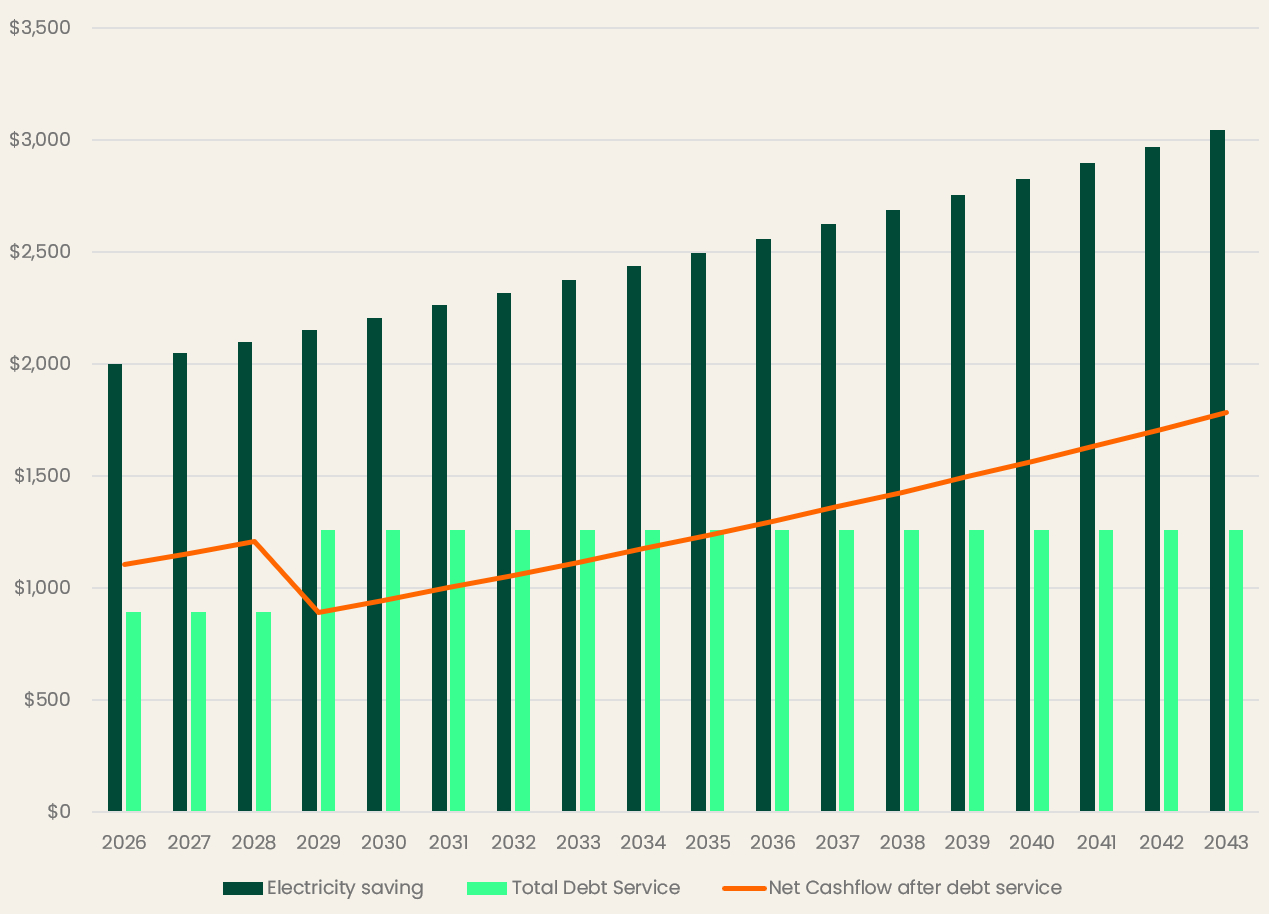
For a home with two to four people and a power bill of around $400 a month, a 16-panel system will generally reduce the bill by roughly $2,000 in the first year, and by an estimated $65,000 across the first 25 years.2
Of the $2,000, around half of this ($1,000) will be used to pay the interest and principal amount down on a green loan (over the first 3 years), which means there is $1,000 of surplus cashflow that can be reinvested into savings, the mortgage etc3. This can seriously supercharge the financial prosperity of Kiwis.
The numbers are fairly similar (ie around $500- $1,000) for a 15 year low interest loan like that proposed by both National and Labour using the ratepayer assistance scheme 4. Based on our numbers, if the government wishes to use this scheme as a catalyst to encourage more solar adoption a 15 year term is a smart move as it will likely add cashflow to a Kiwi household budget. Under a 10 year term the savings will service the loan and the system will pay for itself (which is great), but the 15 year term could provide a real kicker for households to get onboard.
Savings with a green loan
Solar creates financial returns in line with the top performing KiwiSaver funds
Taking the example above and allowing for total costs of ownership (ie an inverter replacement along the way) the estimated annual return is 12.5%5. To put that into perspective, the best KiwiSaver funds have averaged 10% per annum returns before tax over the past decade.6
Solar panels keep delivering savings year on year; they are warranted to still be working at 80% efficiency even after 25- 30 years. Back in the day when these panel warranties were for 10 years, people naturally asked how long a system took to “pay back” because the returns beyond year 10 were uncertain. This is no longer the case. A Kiwi can confidently pay the system off after 6-7 years and know that there’s another $40-$50k of savings backed by the 25-30 year panel warranty.
That means we should start thinking about solar like we do other long term financial assets - ie what is the average return going to be each year. In solar's case, from what we see at Harrisons, this is typically 10 - 15% p.a depending on the size of the system and where you live. Not a bad return and the sun is a lot less volatile than the sharemarket.
Your own numbers will land somewhere else. They depend on your roof, your power use, your tariff and when your household actually uses electricity. Someone home during the day gets a different result from someone out until six. That is exactly what a free on-site solar assessment is for.
So what would kiwis do with this extra cash?
When we put the numbers to our respondents the number who would prioritise solar doubled to just under 66%. The feedback we always hear is that people haven’t had this story explained to them or that their understanding of solar is outdated (this isn't surprising given the residential panels installed in NZ now are commonly 480w - 500w compared to 240w - 260w just 5 years ago and residential power prices have increased by 30% over that time7.
Asked what they would do with the savings from a solar system, they said building up their savings (53%), taking a family holiday (34%), and paying down the mortgage faster (32%).
Where to start
If you're curious about anything we’ve discussed in here feel free to give us a bell. We aren’t here to simply sell you panels and a battery, but help guide you through the process and come up with a tailored solution for you and your family. An in-home assessment is a sensible first step and it doesn't oblige you to anything. Your local Harrisons Solar business owner comes to your place, measures up, looks at your roof and your power use, and talks through what would actually suit your home.
You get a proposal on the spot, so you can go away and think about it with real numbers.
Book a free on-site solar assessment, or call us on 0800 00 33 55.
Notes:
1. Research conducted by Ideally between 20 and 24 July 2026, among a nationally representative sample of 1,058 New Zealanders aged 18 and over. Data weighted by age, gender and region to the latest Stats NZ population estimates. Figures quoted here are from homeowners who do not currently have solar installed (n=592). Study carried out in accordance with ISO 20252:2019.
2. Based on the 8kW system detailed at harrisonssolar.co.nz/solar-systems/8kw-solar-system
3. Assuming a 1% interest rate for 3 years followed by a 6% interest rate with the loan paid off over 18 years.
4. Assuming a 5% interest rate for 15 years.
5. Example generated using OpenSolar software and provided as a guide only. Assumes panels installed at a 25-degree pitch on a north facing single storey house. Actual results will vary depending on the property, electricity usage, installation requirements, electricity tariff and household energy use patterns.
6. Source https://www.smartinvestor.sorted.org.nz/
7. Source: www.mbie.govt.nz QSDEP
Book your free quote
Book a free, no-obligation on-site assessment at a time that suits you. We'll size up your roof, talk you through your options without the jargon, and give you a proposal on the spot.

How we've helped our customers
Hear from customers on how solar has made a real dent in their power bill.


Get your Beginners
Guide to Solar
Download our guide to learn:
How solar saves you money
How a solar system works
If your roof is right for solar
How to choose an installer
And more